Showing posts with label Surgery. Show all posts

3/27/2026

DORV-Adequacy of distance between TV and PV for an intracardiac baffle vs. Rastelli


Figures from Aldo Castaneda's book.

Separation between TV and PV should at least the diameter of AoV. Otherwise, SubAS within the baffle will result either at surgery or later.
(DORV-"Normally-related" Great Arteries)


10/07/2016

STAT Categories: Procedure-specific Mortality Risk Categories

Based on JTCVS 2009;138:1139
(Click on the image to enlarge)


9/10/2016

Blalock-Hanlon Atrial Septectomy (d-Transposition of Great Arteries)

This is performed without cardiopulmonary bypass.
(Click on the image to enlarge)
From Clinical Aspects of Operable Heart Surgery 1968. Donald Kahn, Ruth Strang and William Wilson. Appleton-Century-Crofts (Meredith Corporation), New York. 1968.

Mustard Operation for d-Transposition of Great Arteries

(Click on the image to enlarge)
From Clinical Aspects of Operable Heart Surgery 1968. Donald Kahn, Ruth Strang and William Wilson. Appleton-Century-Crofts (Meredith Corporation), New York. 1968.

11/30/2015

Trusler Rules for Pulmonary Artery Banding

Banding material: 4-mm wide band of Teflon with silicone rubber coating.

General rules: For infants < 1 year of age -

(i) Left to right shunting, no other intracardiac mixing disorders: Can have relatively tight band. Therefore, band circumference = 20 mm + 1 mm/kg body weight.
(Hopefully, the Qp/Qs will be close to 1:1)

(ii) If there is ASD or MPA diameter is large, band can be slightly looser.
Therefore, add 1 or 2 mm to the band circumference.
(Reasons: Presence of large ASD will cause too much cyanosis which will not be tolerated. When MPA is large, band causes folds of arterial wall which will decrease the lumen size and therefore, will be equivalent to a tighter band).

(iii) Bidirectional shunting is present, TGA, etc. - Looser band is needed.
Therefore, band circumference = 24 + 1 mm/kg of body weight.
(In these circumstances, pulmonary blood flow needs to be close to Qp/Qs of 2:1 than 1:1).

(iv) In the presence of pulmonary hypertension, PA band is usually looser than above. The PA band is tightened until distal PA pressure is 50% of systemic pressure. (This was performed in 17 of 209 patients. These 17 patients were excluded from the study).

Intraoperative adjustments to the PA band size: The band should be loosened if (i) distal PA collpases, (ii) cyanosis or (iii) bradycardia occurs.

PA band should be more distal in babies who will undergo arterial switch operation later.

Reference:
Pulmonary Artery Banding. Albus RA, Trusler GA, Izukawa T and Williams WG. JTCVS 1984;88:645-653.

Preparing the band material - Letter to the editor. JTCVS 1984;88:792.

Trusler GA, Mustard WT. A method of banding the pulmonary artery for large isolated ventricular septal defect with and without TGA. Ann Thoracic Surg 1972;13:351-55.

Click here to see related post in Journal Club blog

8/19/2014

VSD enlargement (Surgery)

To enlarge the VSD without causing AV block...

D-loop ventricles - Raise the roof (Enlarge VSD in anterior-superior direction)
L-loop ventricles - Lower the floor (Enlarge VSD in posterior-inferior direction)

Without injuring the aortic valve in the process!

11/15/2012

Indication for Surgery in Marfan Syndrome

Single institution experience. Take it with "a pinch of salt".
(Mt Sinai Medical Center, New York, NY - Dr. Randall Griepp is the senior author)
Diameter = Diameter at Sinus of Valsalva (SoV)
Ratio (Aortic ratio) = Observed diameter/Predicted diameter at SoV

Predicted diameter of SoV is determined from regression formula ("reportedly" derived from Roman MJ et al. AJC 1989:64:507-12). It "appears" that the regression formulas dervice the expected mean value - not clarified in the referenced article (Leget et al. Heart 1996;75:389-95).
Regression formula for "Predicted diameter of SoV" in cm. are as follows:
Child (< 18 yrs): 1.02 + (0.98 x BSA in m2)
Adult (18-40 yrs): 0.97 + (1.12 x BSA in m2)
Adult (> 40 yrs): 1.92 + (0.74 x BSA in m2)

Ann Thoracic Surg 1999;67:1834-9.

6/06/2012

RACHS Score categories

Jenkins, KJ et al. JTCVS 2002;123:110-8

Risk Adjusted Congenital Heart Surgery Score

RACHS category 1:

1. Secundum ASD

2. Aortopexy

3. PDA (> 30 days of age)

4. Coarctation (> 30 days of age)

5. PAPVR repair


RACHS category 2:

1. Aortic valvuloplasty (> 30 days of age)

2. SubAS resection

3. Pulmonary valvuloplasty or replacement

4. RV infundibulectomy

5. RVOT augmentation

6. Coronary fistula repair

7. ASD & VSD repair

8. Primum ASD repair

9. VSD repair

10. Tetralogy repair

11. VSD closure with PA band removal

12. Repair of unspecified septal defect

13. TAPVR repair (> 30 days of age)

14. Glenn shunt

15. Vascular ring surgery

16. A-P window repair

17. Coarctation repair (≤ 30 days of age)

18. PA stenosis repair

19. Common atrium closure

20. LV-RA shunt repair


RACHS category 3:

1. AVR

2. Ross procedure

3. LVOT patch

4. Ventriculomyotomy

5. Aortoplasty

6. Mitral valvuloplasty or replacement

7. Tricuspid valvuloplasty or valvectomy or replacement

8. Tricuspid valve repositioning (Ebstein’s) (> 30 days of age)

9. Anomalous coronary artery repair with or without intrapulmonary tunnel (Takeuchi)

10. Closure of semilunar valve (aortic or pulmonary valve)

11. RV-PA conduit

12. LV-PA conduit

13. DORV repair with or without RV obstruction

14. Fontan

15. AVSD (complete or transitional) repair with or without valve replacement

16. PA banding

17. Tetralogy with Pulm. Atresia repair

18. Cor triatriatum repair

19. Systemic-Pulmonary artery shunt

20. Atrial switch operation

21. Arterial switch operation

22. Pulmonary artery reimplantation

23. Annuloplasty

24. Coarctation & VSD repair

25. Cardiac tumor excision


RACHS category 4:

1. Aortic valvuloplasty (≤ 30 days of age)

2. Konno procedure

3. Complex defect (Single ventricle) repair with VSD enlargement

4. TAPVR repair (≤ 30 days of age)

5. Rastelli procedure

6. Atrial switch with VSD closure

7. Atrial switch with subpulmonary stenosis repair

8. Arterial switch with PA band removal

9. Arterial switch with VSD closure

10. Arterial switch with subpulmonary stenosis repair

11. Truncus repair

12. Repair of … or interrupted aortic arch with or without VSD repair

13. Unifocalization … Tetralogy-PA

14. …


RACHS category 5:

1. Tricuspid valve repositioning for neonatal Ebstein’s (≤ 30 days of age)

2. Truncus with Interrupted aortic arch repair


RACHS category 6:

1. Norwood operation

2. …


5/23/2012

Retroaortic Innominate Vein

Panel A: (6th week of gestation). 1 & 2 - Right and Left anterior cardinal veins, 3 - Primitive aorta, 4 & 5 - Superior and Inferior transverse venous plexus, 6 - Right & Left common cardinal veins, 7 & 8 - Right and left posterior cardinal veins, 9 - Sinus venosus, 10 - Vitelline vein, 11 - Umbilical vein, 12 - Developing IVC

Konstantinov I. E. et al.; Ann Thorac Surg 2003;75:1014-1016

8/02/2011

Surgery: Indications for surgery in Ebstein's anomaly

From Mayo clinic (Mair DD et al. Surgical repair of Ebstein's anomaly:Selection of patients, early and late operative results. Circ 1985;72:II70-II76)

1) NYHA III or IV
2) NYHA I and II, but with CT ratio 0.65 or more.
3) Significant cyanosis (80% or less; Hb 16g% or more)
4) Paradoxical embolism
5) Intractable arrhythmia (even though arrhythmia will not be altered by surgery, but it will be better tolerated after surgery)

Indications for surgery in infants with cyanosis and CHF are less clear. Should be individualized.

Also, see other posting on Neonatal Ebstein's Anomaly Management.

5/18/2011

TAPVR - Sutureless repair vs. Conventional Repair Comparison

JTCVS 2011;141:1346-54
1997-2009
n=57 patients (36 had conventional repair and 21 had sutureless repair)
See also previous posting on this subject


3/26/2011

Surgery - Cath: Rapid development of Veno-Venous Collateral after Glenn Operation

Dilawar, M. et al. Circulation 2001;104:e41-e42

Panel a: Preop. Angiogram


Panel b: 17th postop. day after Glenn operation
(Discharged home on Postop day 8 with 82% saturation in room air. Readmitted on postop. day 17 with 60% saturation)


Panel c: Closed using Amplatzer PDA device.

3/10/2011

Surgery: Multiple VSDs with TGA - Internal RV "band"

The Annals of Thoracic Surgery
Volume 91, Issue 1, January 2011, Pages 289-291

Case reportInternal Right Ventricular Band for Multiple Ventricular Septal Defects in a Neonate Undergoing Arterial Switch and Aortic Arch Repair
William W. Carroll, Girish S. Shirali and Scott M. Bradley

A neonate presented with d-transposition of the great arteries, aortic arch hypoplasia, aortic coarctation, and multiple ventricular septal defects. During the arterial switch procedure and the aortic arch repair, a fenestrated Gore-Tex disk (W.L. Gore & Assoc, Flagstaff, AZ) was sewn into the right ventricular outflow tract to restrict pulmonary blood flow. The internal right ventricular band successfully controlled the pulmonary blood flow, maintaining a systemic oxygen saturation of 88% to 92%, and allowing growth from 3.5 to 10.5 kg. At 8 months of age, the internal band in the patient was removed, and the ventricular septal defects were successfully closed.k


3/04/2011

ICU: Cardiopulmonary interaction, s/p Glenn operation

JTCVS 2003;126:1033-39
Scott Bradley et al.
Hypoventilation strategy to improve oxygenation after Glenn operation:
Protocol in Table 1, Response in other figures:


1/25/2011

General Cardiology: Hypertension following coarctation repair


Incidence of hypertension after coarctation repair increases proportionately with increasing age at repair.


12/17/2010

Surgery: L-TGA with Pulm. Atresia, Alternative Surgical Option


An alternative approach to the surgical management of physiologically corrected transposition with VSD and PS or P.atresia. Ilbawi, MN, et al. JTCVS 1990;100:410-5


7/25/2010

Surgery: Pulmonary atresia - VSD, MAPCAs, Unifocalization

Staged repair of tetralogy of Fallot with pulmonary atresia and major aortopulmonary collateral arteries. Duncan, BW., Mee, RBB, et al. JTCVS 2003;126:694-702.


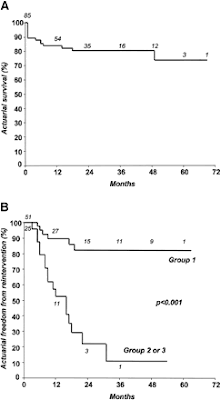
Bill Brawn group: JTCVS 2004;127:251-8
Treatment algorithm:

Survival after first surgery:

Freedom from reintervention (surgery or cath) after complete repair:

Frank Hanley group re: Surgical creation of "A-P window"
Rodefeld, MD. et al. JTCVS 2002;123:1147-54.
Selection criteria for surgical creation of A-P window:
1) Presence of centrally confluent pulmonary arteries (1 - 2.5 mm in diameter with well-developed peripheral arborization)
2) Multiple, hypoplastic AP collaterals that communicated with true pulmonary artery system
3) Presence of marked cyanosis
Avoid this procedure in the following situations:
1) High flow from MAPCAs
2) Isolated supply from MAPCAs (indicates native PAs do not have good peripheral arborization...to stand the high flow-high pressure from aorta)
3) Native PAs > 2.5 mm and
4) non-confluent native PAs.

Frank Hanley group: (Circulation 2000)
V. Mohan Reddy et al. Circulation 2000;101:1826-32
Early and Intermediate outcomes after repair of pulmonary atresia with ventricular septal defect and major aortopulmonary collateral arteries.
Treatment algorithm


Also see:

Journal Club: PA-VSD, MAPCAs, Unifocalization

MAPCAs in PA-VSD

Preop Evaluation of PAs in PA-VSD

7/23/2010

Anatomy: Preop. evaluation of pulmonary arteries/MAPCAs in Pulmonary Atresia - VSD

Review article

1) McGoon ratio:
(Diameter of RPA/DAo + Diameter of LPA/DAo)
Normal 2.1
Adequate for VSD closure 1.2
Inadequate <0.8 for VSD closure

2) Nakata Index:
(CSA of RPA + CSA of LPA)/BSA
Normal value > 200 mm2/m2
> 150 mm2/m2 is adequate.
(Not usable preoperatively when MAPCAs are the major source of PBF & one-stage unifocalization + full repair is planned).
(> 200 for single ventricle repair, > 100 for 2-ventricle repair...check correctness of this statement first)

3) Total Neo-Pulmonary Artery Index (TNPAI) = APC index + Nakata Index
APC index is the sum of CSA of all usable APCs/BSA
>250 - suitable for one-stage repair including VSD closure (These pts. have low RV/LV pressure ratio postoperatively).

Critique of all these indices: These indices consider only the size of proximal vessel and not consider the condition of distal parts of the vessels (which may be stenosed, etc).

Also see:
MAPCAs in PA-VSD
Surgical Outcome (Journal Club blog)
Surgical Treatment algorithm